
Measuring Regret
On Elon Musk's new social media metric

Last week, Elon Musk announced a change to X/Twitter’s1 core algorithm in an effort to reduce “negativity” on the platform. While some users have raised complaints about free speech implications, I was fascinated by Musk’s explanation. In his words, the change aims to increase “unregretted user-seconds.”
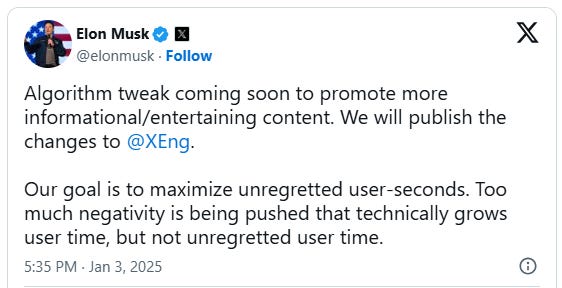
What in the world are those? Well, the best part is that the exact definition remains shrouded in mystery, or at least internal emails. The full term is Musk’s, and it seems to be a UX metric his team has invented and picked as the KPI of all KPIs. In the spirit of ancient explanations of interesting things, it’s helpful to investigate where it comes from, what it’s for, and where it’s taking us.
Musk originally had used “unregretted user-minutes” as the platform’s north star. “User-seconds” seems to have emerged in the UX realm as both a more precise measurement geared to the manic engagement style of social media and a defense against bots. As far as I can tell, the use of “user-minutes” emerges in the postwar era as a measure of telephone use, particularly as a way to quantify outage impacts. It was quickly adopted by the emerging computer science community as a measure of the same. By the dot-com boom, the web analytics field had moved from “unique visitors” and “click-through-rates” (CTR) to measuring engagement by time.2 The social media era has generated a variety of metrics related to what I do with my time on the screen—scrolling, “dwelling,” interacting, etc.
The folks at Twitter/X have pushed this development to its logical conclusion. They want to know if I value my time on social media positively. Or rather, they want to make sure that I don’t evaluate my time negatively. But this essential act of evaluation is what makes “regret” such a difficult and fraught concept to apply to social media. Regret implies later reflection—I used social media, then later I thought more deeply about my use of time, and now I wish I didn’t. This reflection is inevitably a moral evaluation. Not in a moralistic sense (“I’m a bad person for using social media”) but in the true sense of morality, having to do with the goodness of actions and their propensity to lead to my flourishing.3 It’s in this dynamic, I think, that the metric (while laudable in its context-independent aims)4 contains the seeds of its own futility.
I regret most of my social media use. I’d concede that a fair bit is neutral. And then there’s the rare moment of delight or content that seems “just for me” that keeps me coming back.5 But the more I reflect, the more the neutral seconds become regretted seconds, and the more I feel the positive content could be found in other, better places. In fact, to take the time to measure regretted seconds results in more regret.
Now, I’m sure that the UX folks over at The Platform6 have a host of complex measurements that approximate non-regret. But the fact that living a more reflective life might actually change our assessment of social media use suggests this KPI might have unintended consequences. I think it suggests we might pursue ways to get “the good stuff” without engaging in user-seconds at all. Again, I’m sanguine that an artificial intelligence can ironically take on the regrettable side effects of technology, leaving us with delight. Of course, the idea needs some further reflection.
In the meantime, I’ll see you in the margins.
Brett

The ideas expressed here are those of the author, and do not reflect those of any employer or affiliated organization, past, present, or future. They do not constitute an offer or recommendation to buy, sell, use, or discontinue using any security, financial instrument, product, or service. They might not even be accurate. Hopefully they’re thought-provoking.
I’m not sure what to call this thing, and neither is anyone else. The AP Style Guide current insists on a first reference of “X, formerly known as Twitter,” which has some delightful subconscious evocations of a great artist. I imagine for a certain generation it’ll always be Twitter, just like for me Dwayne Johnson’s home will always end with an F.
If you have the time and patience for the individual instances tracked by ye ol’ Google Ngram, you’ll find some gems in the long history of “user-minutes.”
If you have leisure time (yes, leisure, not free time), you might dive down this beautiful rabbit hole.
I’d love to not regret any of my seconds.
Dear AP, I propose this name as an acceptable reference for the next style guide update. It’s vague and unmistakable all at the same time!